Category: Traffic Law
{
“@context”: “https://schema.org”,
“@type”: “Article”,
“mainEntityOfPage”: {
“@type”: “WebPage”,
“@id”: “https://wawerunyamburalaw.com/traffic-offenses-in-kenya-fine-vs-court-guide”
},
“headline”: “Traffic Offenses in Kenya: When to Pay the Fine vs. Go to Court”,
“description”: “Navigate Kenyan traffic laws with confidence. We explain the difference between minor traffic offenses, cash bail, NTSA automated fines, and when to hire a lawyer for court.”,
“image”: “https://wawerunyamburalaw.com/wp-content/uploads/2026/03/traffic-law-kenya-waweru.jpg”,
“author”: {
“@type”: “Organization”,
“name”: “Waweru Nyambura & Co. Advocates”,
“url”: “https://wawerunyamburalaw.com”
},
“publisher”: {
“@type”: “Organization”,
“name”: “Waweru Nyambura & Co. Advocates”,
“logo”: {
“@type”: “ImageObject”,
“url”: “https://wawerunyamburalaw.com/logo.png”
}
},
“datePublished”: “2026-03-18”,
“dateModified”: “2026-03-18”
}
:root {
–waweru-blue: #0056b3;
–waweru-light: #f0f4f8;
–text-dark: #1a1a1a;
–alert-red: #d9534f;
}
.article-container {
max-width: 800px;
margin: 0 auto;
padding: 20px;
line-height: 1.7;
}
h1 {
border-bottom: 4px solid var(–waweru-blue);
padding-bottom: 15px;
margin-bottom: 30px;
color: var(–text-dark);
letter-spacing: -0.5px;
}
h2 {
margin-top: 40px;
margin-bottom: 20px;
color: var(–text-dark);
border-left: 4px solid var(–waweru-blue);
padding-left: 15px;
}
h3 {
margin-top: 30px;
margin-bottom: 15px;
color: var(–text-dark);
font-weight: 700;
}
.lsk-alert {
background-color: #fdf2f2;
border-left: 5px solid var(–alert-red);
padding: 25px;
margin: 30px 0;
border-radius: 4px;
}
.excerpt {
border-left: 4px solid var(–waweru-blue);
background-color: var(–waweru-light);
padding: 25px;
margin-bottom: 40px;
font-size: 1.2rem;
border-radius: 4px;
color: var(–text-dark);
}
a {
color: var(–waweru-blue);
text-decoration: underline;
font-weight: bold;
}
ul, ol {
margin-bottom: 20px;
padding-left: 20px;
}
li {
margin-bottom: 10px;
}
Traffic Offenses in Kenya: When to Pay the Fine vs. Go to Court
If you drive in Kenya, being pulled over by traffic police or NTSA officers is an inevitable reality. A simple traffic stop can quickly escalate into threats of spending the weekend in police cells or having your vehicle towed to the local station.
For most drivers, the immediate instinct is panic, followed closely by the urge to pay a bribe just to make the problem disappear. But in the modern digital era, where the National Transport and Safety Authority (NTSA) is deeply integrated with the e-Citizen portal and the Judiciary, informal shortcuts are becoming highly dangerous.
At Waweru Nyambura Law, we move fast. We believe an informed driver is an empowered driver. Today, we are demystifying the Traffic Act (Cap 403) so you know precisely when to pay the instant fine, when to demand cash bail, and when you absolutely must fight back in court.
1. The “Minor Traffic Offence” Notice (NTAC)
Not every traffic stop warrants handcuffs or a court appearance. Under the Traffic (Minor Offences) Rules, 2016, the Kenyan government decriminalized dozens of common infractions into simple ticketing offenses.
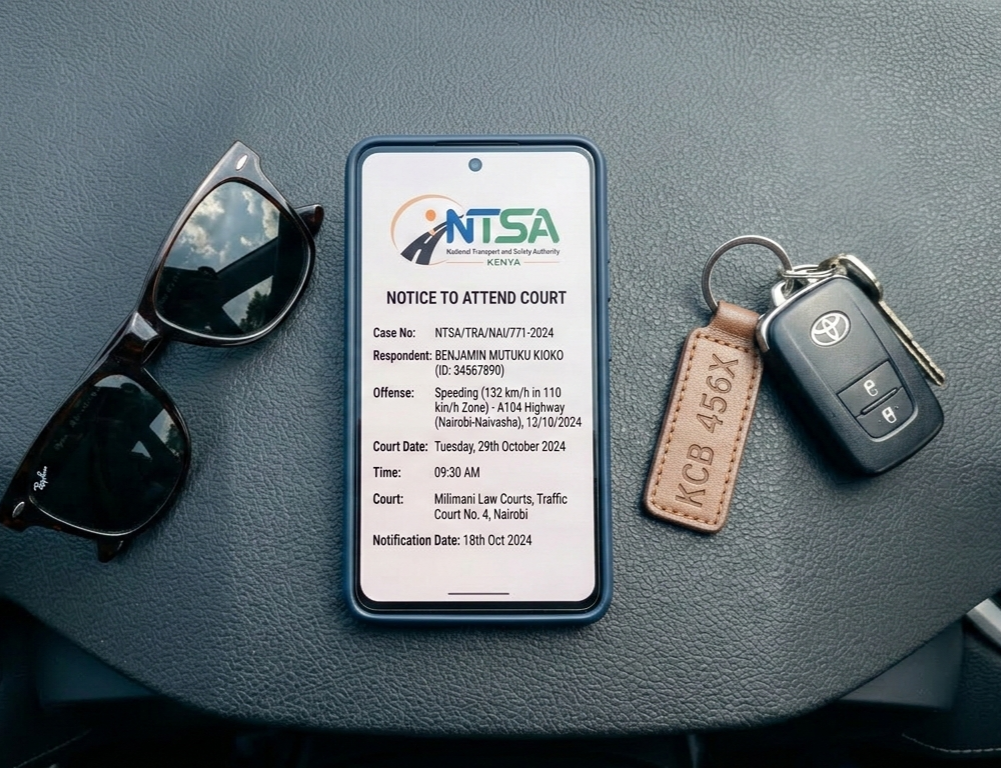
Offenses such as minor speeding (exceeding the limit by less than 20 kph), driving on a worn-out tire, or failing to wear a seatbelt do not warrant a dramatic arrest. Instead, the police should issue you a Notice to Attend Court (NTAC), which is accompanied by an instant fine notification.
To Pay or Not to Pay?
If you receive this notice, you have a strategic choice. You can log into the e-Citizen portal, plead guilty to the minor offense, and pay the statutory fine (typically ranging from Ksh 500 to Ksh 10,000). Once paid, the matter is permanently closed. This is often the most efficient route if you are genuinely at fault and simply want to move on.
However, if you believe the speed gun was defective or the officer acted maliciously, do not pay the fine. Paying the fine is a legal admission of guilt. To contest the charge, you must appear in court on the date stated on the notice and formally plead “Not Guilty.”
2. Cash Bail vs. Bribes: Know Your Rights
What happens when the offense is not classified as “minor,” such as overlapping, driving an un-inspected commercial vehicle, or reckless driving? The officer may legally detain you and take you to the police station.
This is the exact moment where the dangerous confusion between a “bribe” and “cash bail” occurs.
Under Article 49 of the Constitution of Kenya, an arrested person has the fundamental right to be released on bond or bail on reasonable conditions pending a formal court charge. The police are legally authorized to grant you Police Cash Bail right at the station desk.
- A Bribe is unreceipted money given to an officer to destroy the evidence and let you go. It is a severe criminal offense that encourages extortion.
- Cash Bail is a receipted, official deposit held by the state to guarantee you will show up in court on Monday morning. If you attend court, the bail is either refunded to you or applied toward your final fine.
The National Council on the Administration of Justice (NCAJ) directs that traffic offenders should not be remanded in custody for offenses punishable merely by a fine. Always demand a formal cash bail receipt. If the police refuse to grant bail unconditionally, call your lawyer immediately. We intervene directly at the station to enforce your constitutional rights.
3. The Looming Digital Future: NTSA Automated Fines
As you navigate Kenyan roads, you must also be prepared for the technological shift in traffic enforcement. Recently, the government attempted to roll out the Intelligent Traffic Management System (ITMS)—a network of automated cameras on major highways like Thika Road designed to capture license plates, detect speeding or overlapping, and instantly send SMS fines to the registered vehicle owner without any police interaction.
However, these automated fines were temporarily paused by the High Court. The courts cited critical constitutional issues, including a lack of adequate public participation and concerns over the right to a fair trial (e.g., how to automatically prove who was actually driving the vehicle at the time the camera flashed).
While the automated SMS fines are paused for now, they are undeniably the future of Kenyan traffic law. The digital infrastructure is already built and mounted on our highways. As a modern driver, you must ensure your vehicle details are perfectly updated on the NTSA TIMS portal. When these automated systems are eventually cleared by the courts and fully activated, ignoring a digital fine will result in immediate consequences for your online government profiles and your ability to renew crucial documents.
4. When You MUST Fight in Court (Serious Offenses)
While paying an instant fine for a broken tail light makes sense, there are serious offenses where pleading guilty just to “get it over with” will destroy your livelihood.
Drunk Driving (Section 44)
Driving under the influence of alcohol is heavily prosecuted. Under Section 44 of the Traffic Act, pleading guilty or being convicted carries a fine of up to Ksh 100,000, imprisonment for up to two years, or both.
“More importantly, under NTSA guidelines and the Traffic Act, a conviction for drunk driving or causing death by dangerous driving can lead to the mandatory suspension or complete revocation of your driving license. If you drive for a living, pleading guilty without a fight means losing your job.”
Defective Speed Guns & Calibration
Police speed guns are machines, and machines require strict calibration to be legally admissible. In various High Court rulings, judges have thrown out speeding charges because the prosecution failed to produce a valid calibration certificate for the specific speed gun used on that day.
At Waweru Nyambura Law, we do not just accept the police’s word. If you are charged with a serious speeding offense, we demand the technical evidence in court. If the prosecution cannot prove the device was legally accurate and operated by a qualified officer, the charge collapses.
5. Why You Need a Modern Litigator
Handling traffic court alone can be an exhausting, all-day affair that drains your productivity and peace of mind. As modern litigators, we handle the legal friction so you can go back to running your business.
If you are arrested, we move fast to:
- Secure your immediate release on reasonable police bail.
- Appear in court on your behalf (where the law permits) to enter a plea.
- Review the charge sheet for defective drafting (which often gets cases dismissed on technicalities).
- Negotiate with the prosecutor or fight the evidence in a full hearing.
Don’t let a traffic stop turn into a permanent criminal record.
Arrested or facing a serious traffic charge?
[WhatsApp Us Now] for urgent representation at the police station or in court.